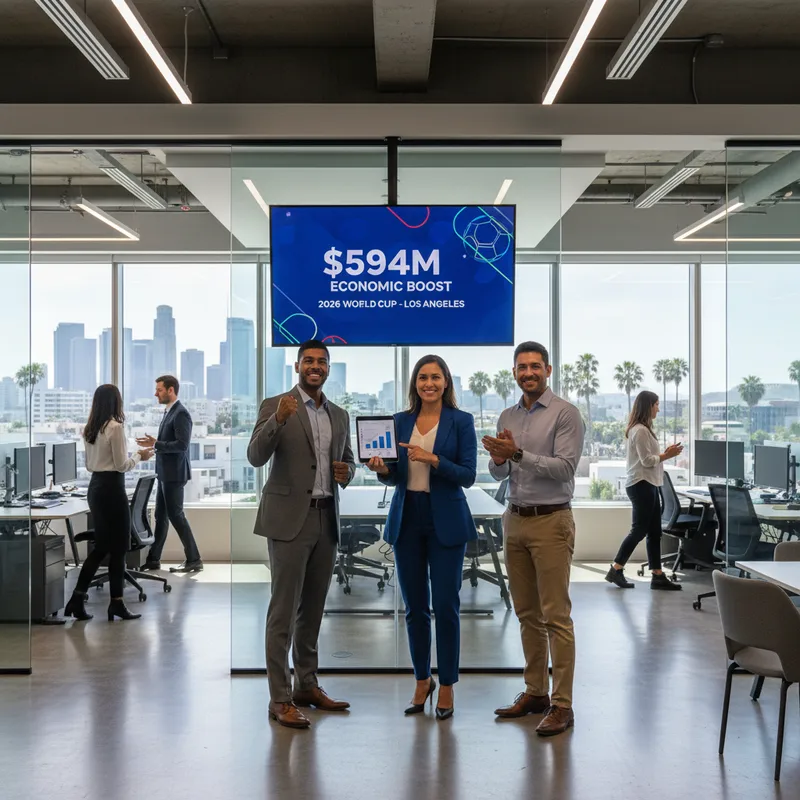
The 2026 FIFA World Cup is projected to inject an astonishing $594 million into the Los Angeles economy, according to a new analysis detailing the financial impact of the world’s most popular sporting event. As one of 11 U.S. host cities, Los Angeles is preparing to welcome a massive influx of visitors and capture a significant share of the tournament’s economic benefits.
The report, conducted by Bookies.com, estimates that nearly 180,000 visitors will descend upon the Los Angeles area between June 11 and July 19 for the tournament. These fans are expected to spend approximately $60 million on local goods and services, including food, transportation, entertainment, and accommodations. The hospitality sector is poised for a major windfall, with local hotel revenues predicted to increase by 22 per cent during the six-week event.
SoFi Stadium in Inglewood will be the epicentre of the action in Los Angeles, hosting eight matches. This includes the highly anticipated opening match for the United States Men’s National Team (USMNT) against Paraguay. The high number of games positions Los Angeles as not just a key stage for the competition, but also as one of its biggest financial beneficiaries.
The significant economic activity hinges on smooth operations, however, with a potential labour dispute looming. SoFi Stadium hospitality workers recently authorized a strike that, if it proceeds, could disrupt services during the tournament. Barring any industrial action, beer sales alone at the stadium are projected to generate nearly $15 million across the eight matches.
A premier destination for a global event
The World Cup’s structure, which unfolds over several weeks, provides a sustained economic stimulus that few other events can match. It differs from a single-game championship or a weekend-long festival, creating a prolonged wave of tourism and spending that benefits an entire metropolitan area.
This is exactly the type of event cities spend decades trying to attract.
Daniel McIntosh, faculty director of the Sports Business Program at Arizona State University, who contributed to the analysis, said that cities with specific attributes stand to gain the most. He noted that strong tourism infrastructure, international appeal, and a schedule with multiple matches are the key ingredients for maximizing the economic return. Los Angeles, with its extensive airport, public transit network, and global recognition, checks all of those boxes.

While Los Angeles is set for a massive boost, it is projected to have the second-most visitors of any host region, trailing only the New York and New Jersey area. That region will host eight matches as well, including the World Cup Final on July 19.
California to lead the nation in economic gains
The economic impact extends across the entire state of California, which is the only state besides Texas to feature two host markets. The Bay Area, where matches will be held at Levi’s Stadium in Santa Clara, is projected to see a $400 million economic impact. Combined, the two California regions are expected to generate nearly $1 billion, making the state the most powerful economic engine of the tournament in the United States.
Nationally, the 2026 World Cup’s financial footprint is staggering. The total economic impact across all 11 U.S. host cities is forecast to exceed $5 billion. FIFA’s own projections are even more optimistic, suggesting the tournament could add $17.2 billion to the U.S. gross domestic product and create more than 290,000 jobs nationwide. Attendance is expected to hit 6.5 million, nearly double the figure from the last time the U.S. hosted the tournament in 1994.
However, the benefits will not be distributed equally. Dallas, which will host nine matches, is projected to lead all U.S. cities with an economic impact of roughly $1.8 billion, followed by Houston ($1.5 billion) and Seattle ($929 million). Kansas City ($653 million) is also projected to see a slightly larger return than Los Angeles ($594 million), which is followed by Miami ($550 million).
Spending, betting, and a look to the future
Analysis of visitor spending habits shows that more than half of all expenditures are expected to be on food and beverage purchases. Hotels are projected to account for about one-third of spending, with the remainder going to local transportation. In anticipation of the event, official World Cup retail stores have already opened in Los Angeles.
One notable aspect of California’s hosting role is the state’s current ban on legal sports betting. While millions of fans descend on the state, they will be unable to place legal wagers on the matches they attend. This is particularly significant as economists predict that global betting activity on the 2026 World Cup will shatter all previous records.
It has been 32 years since the United States last hosted the men’s World Cup, and California appears ready to capitalize on soccer’s biggest spectacle. As the state prepares for the influx of fans and global attention, many see this as a precursor for another major global event on the horizon.
The successful execution of the World Cup will likely serve as a valuable test run and a preview of what lies ahead when the world returns to Los Angeles in 2028 for the Summer Olympics.